
Projects
Small open-source projects, mostly in Python, on electrochemical simulation, data analysis and modelling, plus an offline AI lab assistant. All code is on GitHub.
Local AI for lab data

offline-lab-assistant
An offline AI lab assistant: Lina, a local language model in LM Studio, calls a tested Python tool through MCP to check calibration linearity and calculate LOD/LOQ, so research data never leave the computer.
Electrochemical simulation
CV-simulation
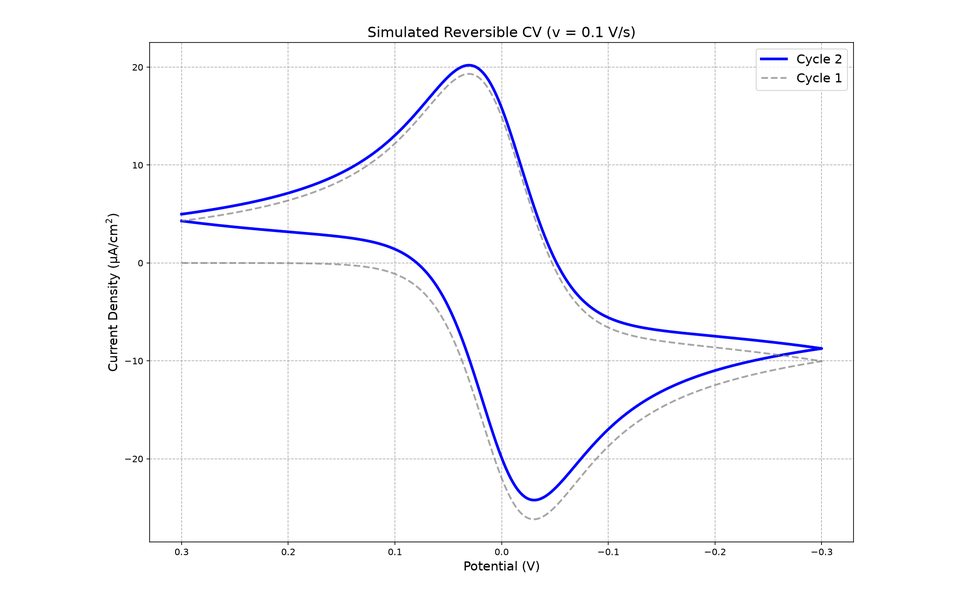
Simulates cyclic voltammetry of a reversible redox couple at a planar electrode by solving Fick's second law with an explicit finite-difference scheme under Nernstian conditions.
SWV-Simulator
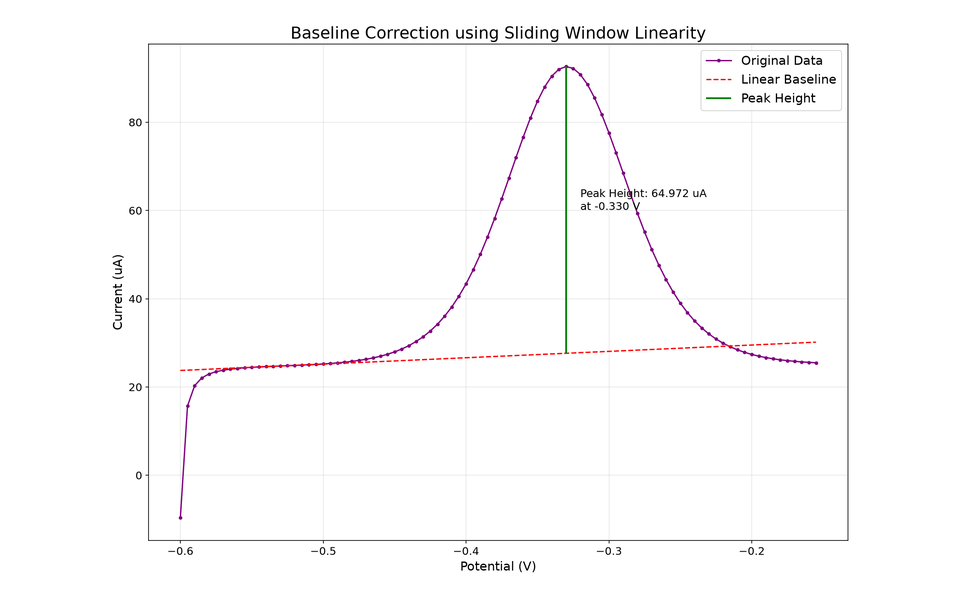
Simulates square-wave voltammograms with a charging-current baseline, then extracts the faradaic peak height by sliding-window linear baseline fitting.
PINN-diffusion-study
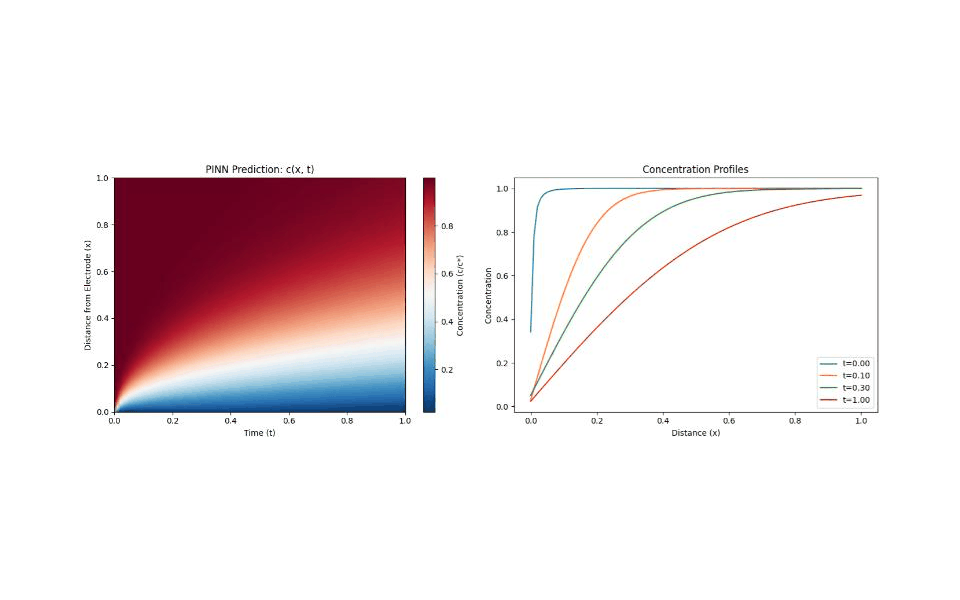
A physics-informed neural network (PyTorch) that solves the diffusion equation for concentration depletion near an electrode, trained on the governing equation and boundary conditions instead of data.
Electrochemical data analysis
CV-anodic-peak-extraction
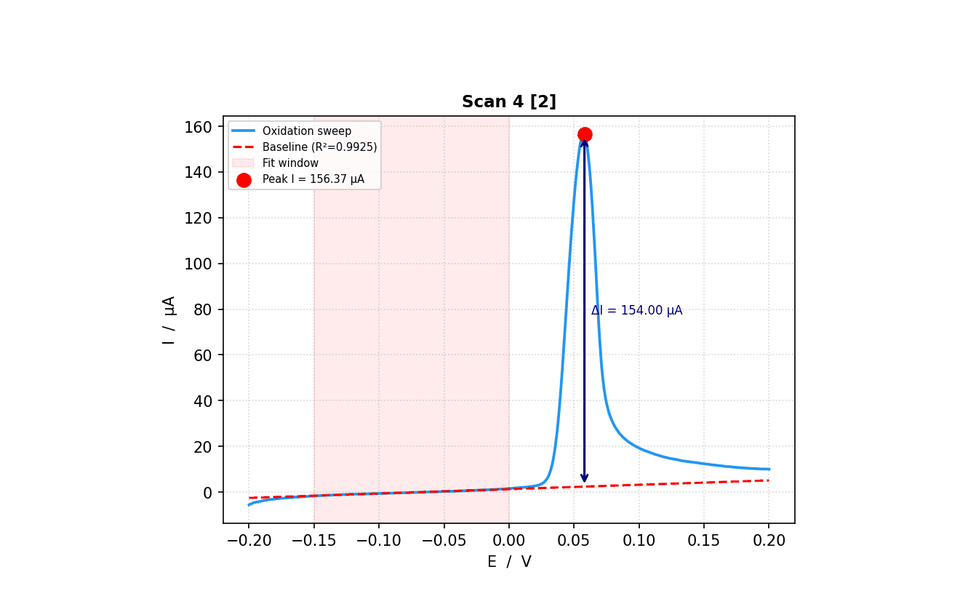
Notebook that fits a linear baseline in a pre-peak window and extracts anodic peak currents from multi-cycle CV exports (PalmSens PSTrace), averaged over consecutive scans.
originlab-voltammetry-peaks
Python script for OriginLab that finds voltammetric peaks in Gamry files, subtracts a user-defined baseline and reports mean ± SD peak heights over cycles.
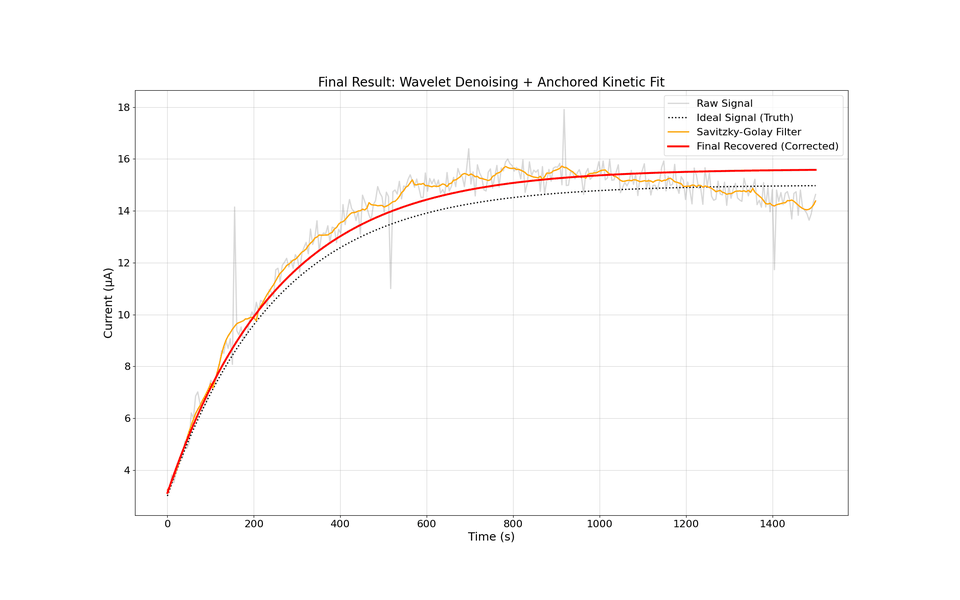
Electrochemical-Wavelet-Denoising
Denoising of simulated sensor binding-kinetics data with Savitzky–Golay smoothing and wavelet thresholding, followed by an anchored kinetic fit to recover the binding rate constant.
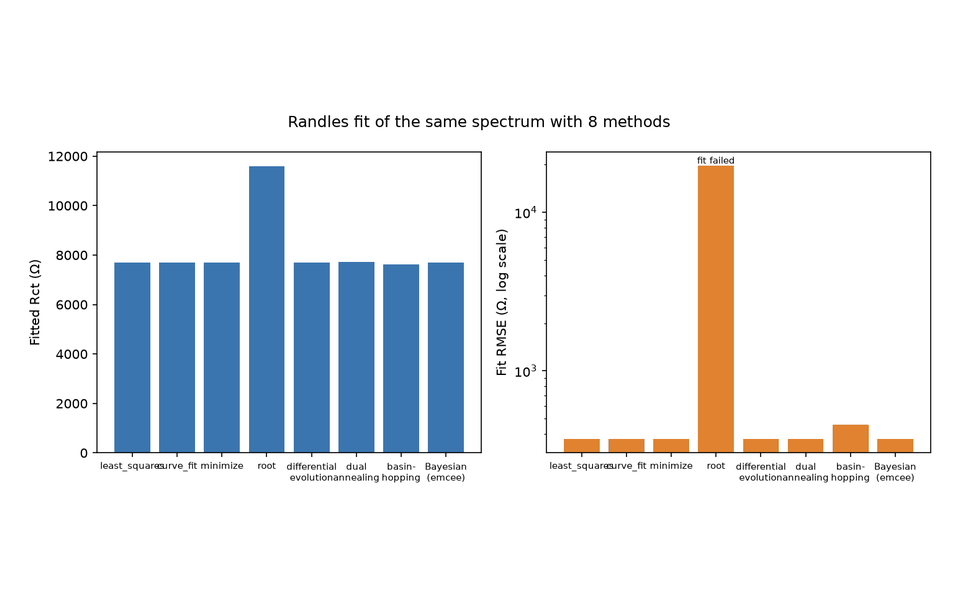
EIS_Randles_Fitting
Fits impedance spectra to a Randles circuit with eight methods (local least squares, global optimizers and Bayesian MCMC) and compares the results.
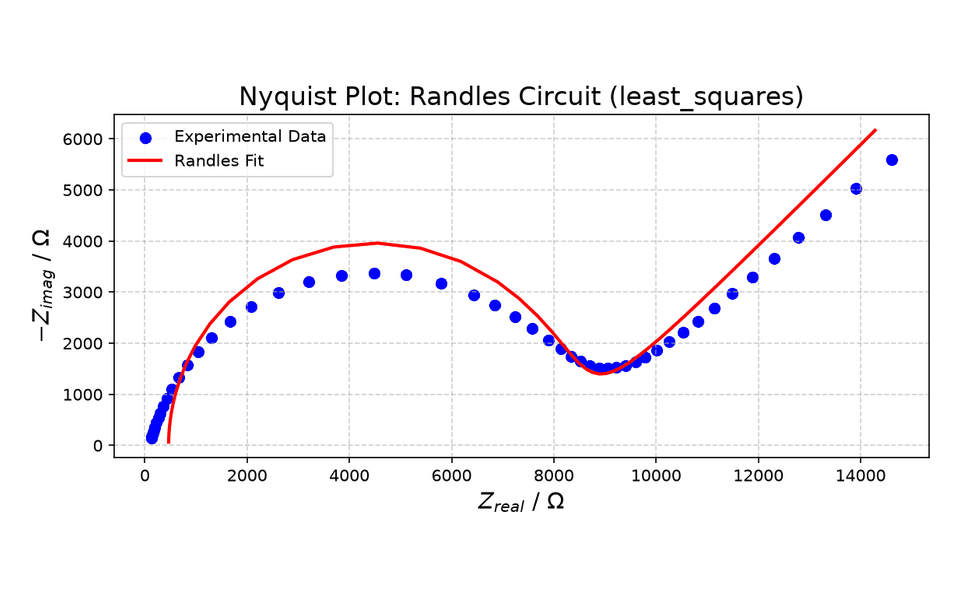
EIS-Fitting-Models
Fits impedance spectra with three equivalent circuits: Randles (sensors), modified Randles and a two-RC Thevenin model (Li-ion batteries).
Machine learning for electrochemical sensing
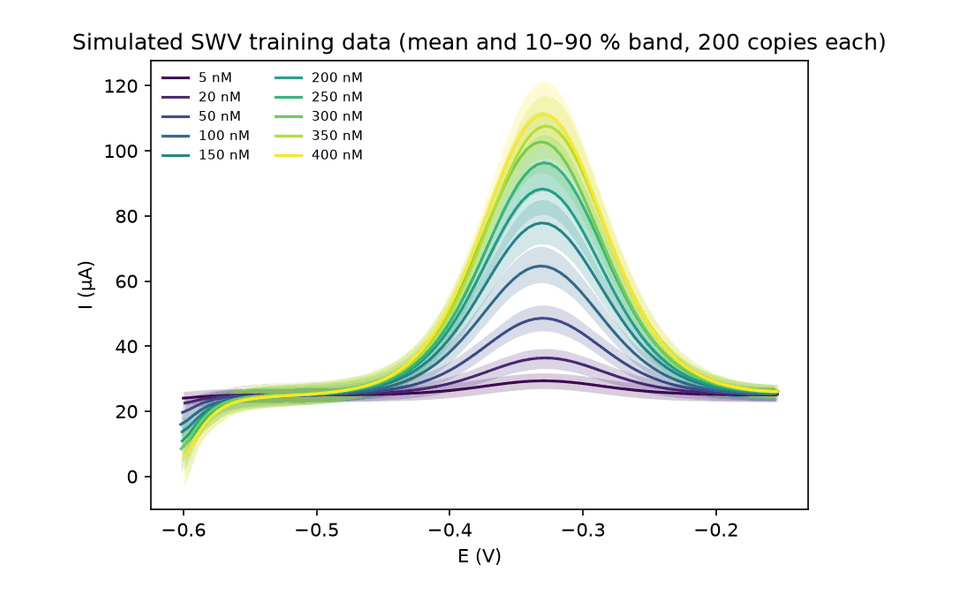
SWV-Concentration-Prediction-ML
Compares 1D-CNN, LSTM/GRU and hybrid CNN–Transformer models that predict analyte concentration directly from simulated, augmented SWV curves of MIP sensors.
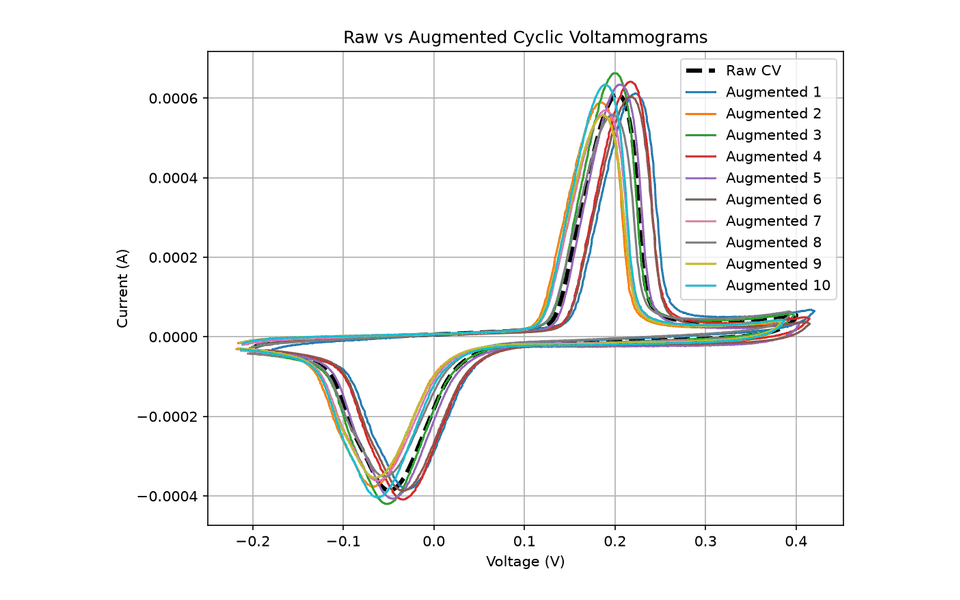
cv-data-augmentation
Augmentation methods for cyclic voltammetry data (potential shift, current scaling, baseline drift, peak broadening, warping and noise) to build machine-learning training sets.
MIPs, materials and molecular modelling
SEM-BSE-image-analysis-MIP-RuO2
Corrects backscattered-electron SEM images for emission-current differences between sessions and compares bare and MIP-modified RuO₂ screen-printed electrodes.
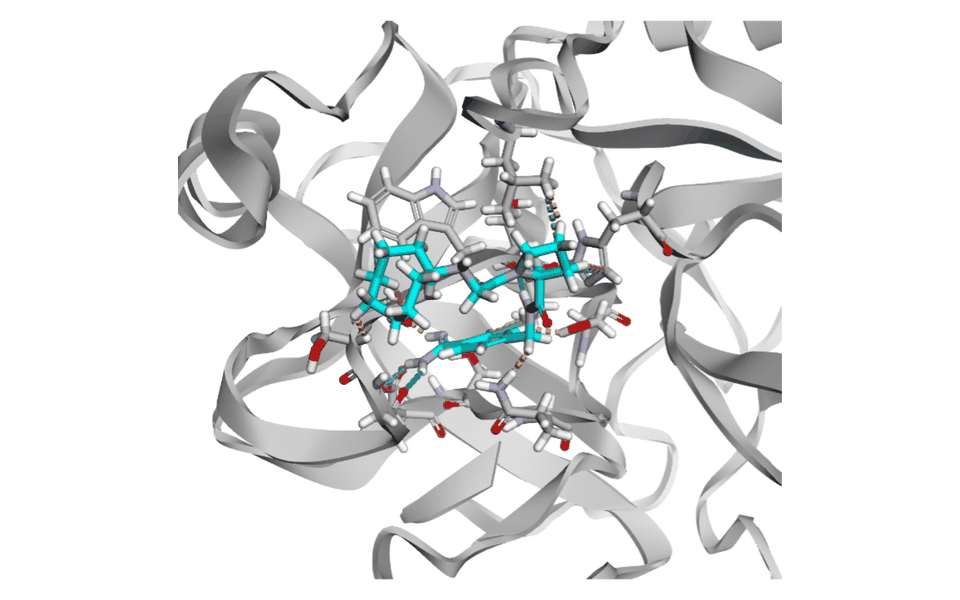
Python-Molecular-Docking
Docking workflow following the RCSB PDB-101 Python training: ligand preparation with Meeko, docking with AutoDock Vina and interaction fingerprints with ProLIF.
MIP-eQCM-Theory-Handbook
Theory notes on molecularly imprinted polymers (imprinting approaches, computational monomer selection, electropolymerization, class-selective MIPs) and on the electrochemical quartz crystal microbalance (working principle and equivalent circuit model).
Batteries and fuel cells
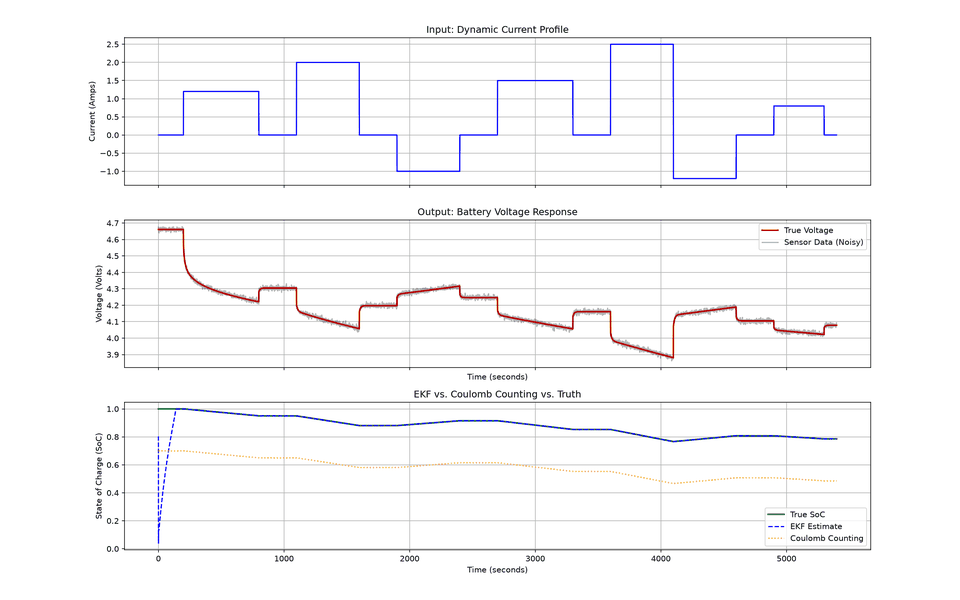
battery-ekf-soc-estimator
Extended Kalman filter for Li-ion state-of-charge estimation with a 1RC equivalent-circuit model under a dynamic current profile.
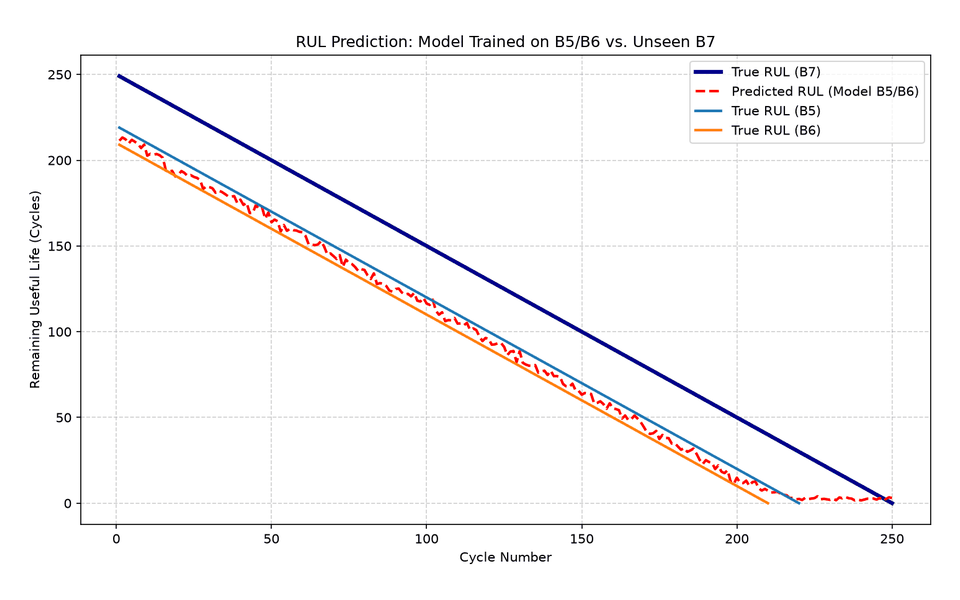
Li-ion-RUL-Prediction
Remaining-useful-life prediction on NASA battery degradation data, with correlation analysis and random-forest regression validated on an unseen cell.
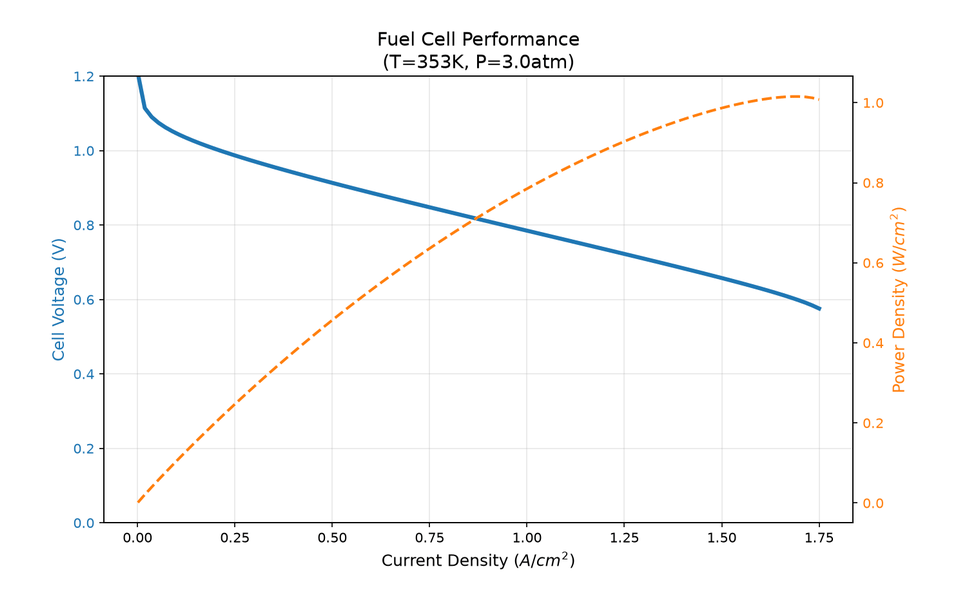
pem-fuel-cell-model
Physics-based PEM fuel cell simulator (Nernst voltage with activation, ohmic and concentration losses) giving polarization and power curves.